
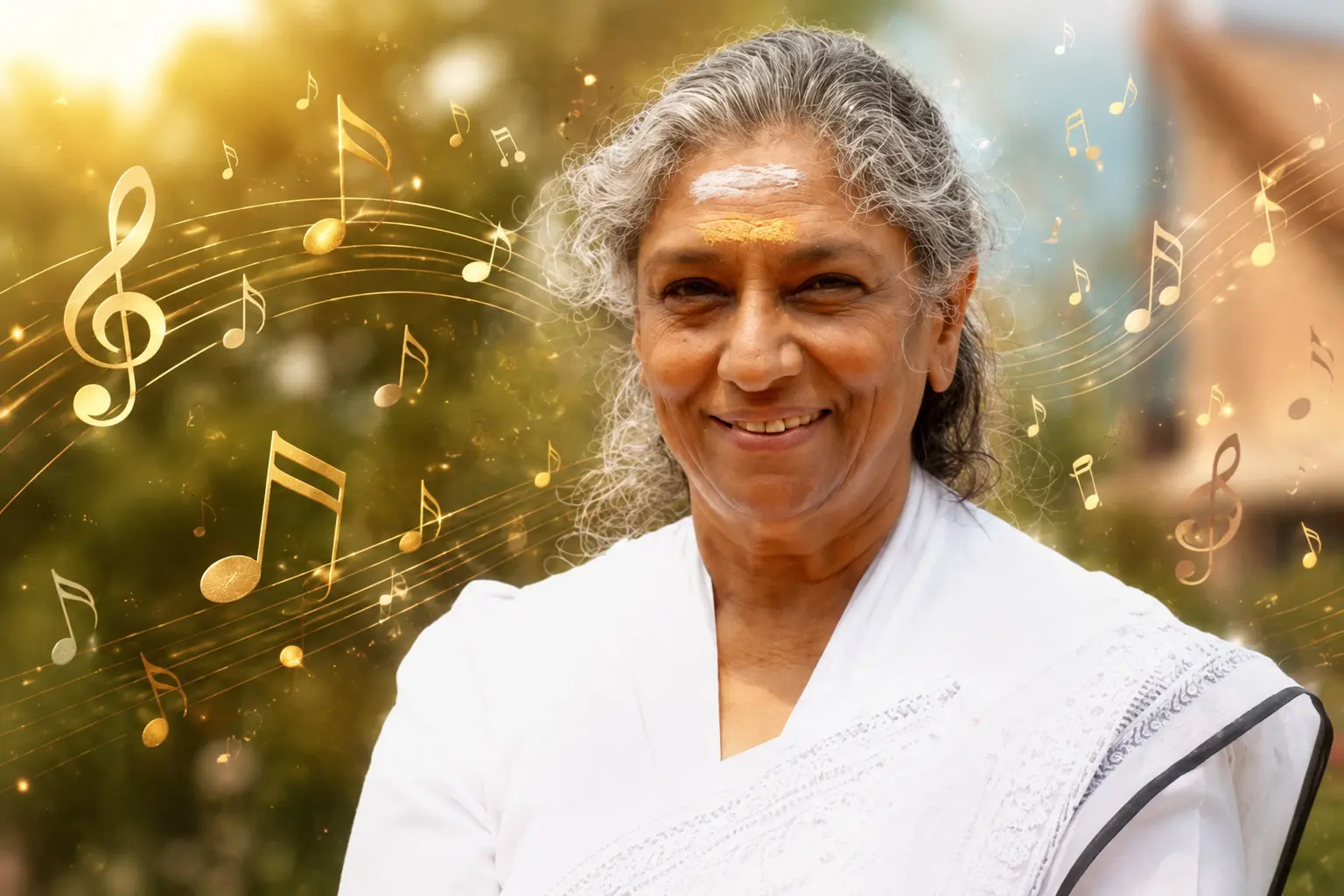
Remembering S. Janaki: The Soul of South Indian Music
Table of Contents
S. Janaki, lovingly called Janaki amma, was more than a voice for me; she was the soul of many memories. For me, her songs formed the soundtrack of childhood — in my home, on the radio, and inside the movies that shaped our mornings and evenings. She sang in Malayalam, Tamil, Hindi, and many other languages, and her duets with K. J. Yesudas remain among the most cherished moments in Malayalam cinema and are my all-time favourites. Today we remember her not just as a singer but as an artist who made millions of emotions sound like music.
A voice that belonged to everyone
Janakiyamma’s voice could be playful, devotional, melancholy or ecstatic, and it always felt perfectly honest. She moved effortlessly across languages and genres, which made her uniquely suited to India’s multilingual film culture. Whether she was rendering a lullaby in Malayalam, an intense Tamil melody, or a tender Hindi film number, her voice retained a vivid personality — warm, expressive, and immediately recognizable.
Early life and rise
Born into modest surroundings, Janaki’s musical sensibilities were nurtured from an early age. Dedicated training and an uncanny ability to adapt helped her find steady work across South Indian film industries and beyond. Over the decades, she sang thousands of songs, won many awards, and became the first choice for music directors seeking a singer with depth and range.
The magic of Janaki–Yesudas duets

One of the sweetest chapters in Malayalam film music is the pairing of S. Janaki and K. J. Yesudas. Their voices blended like two colors that always matched — Yesudas’s honeyed baritone and Janaki’s expressive timbre created duets that felt both intimate and cinematic. Many of my favorite Malayalam duets — the ones that linger in memory — are theirs. They captured romance, longing, playfulness, and sorrow with an effortless chemistry that sometimes felt like a conversation rather than a song.
Memorable songs and contributions
• Malayalam classics: Janaki brought life to countless Malayalam songs across genres — from romantic hits to devotional and folk numbers. Her phrasing and emotive nuances made each lyric believable and touching.
• Tamil mastery: In Tamil cinema, she delivered some of the most iconic melodies with top composers, shaping the sound of several eras.
• Hindi and pan-Indian work: Though primarily known for South Indian music, Janaki sang beautiful Hindi numbers and worked in multiple languages, making her a truly pan-Indian talent.
• Playback versatility: She sang for heroines across generations and adapted to different actors’ screen personas, a rare skill that made her indispensable to filmmakers.
Why her voice mattered to me
Janakiyamma’s voice was the warm thread that stitched together so many small moments of my childhood. Her songs were everywhere — on the radio, at family gatherings, and on TV. They became a gentle teacher of emotion: how to feel longing, joy, devotion, and grief. All her duets with SPB were soulful, and with Kishore Da were amazing. But her duets with Yesudas felt like the soundtrack of everyday life – festive songs, monsoon melodies, lullabies. Whenever I hear one of those duets now, I’m transported back to those simple moments of childhood wonder.
- The gentle lullaby “Araro Ariraro Achante Mol Araaro” was the soundtrack to lulling the children to sleep in our home. The song was not just music; it was a ritual every night.
I have been lucky enough to put all my cousins to sleep. I used to have to sing a lot of songs to get them all to sleep. This was always the first song. Even though times have changed, it is still the same starter lullaby.
- Songs like “Kaattu Tarattum” “Neela Jalashayathil” and “Manjani Kompil” are slow, soothing melodies of rainy evenings; the scent of damp earth and tea is more inviting than the rain outside the house.
- We felt the agony reflected in songs like “Mizhiyoram“, “Swarnamukile” and “Sandhye Kanneerithenthe” and the deep love in “Natha Nee Varum Kaalocha”. Our childhood memories were sketched in the song “Oru Vattam Koodiyen Ormakal”. And “Thenum Vayambum Naavil Thukum Vanampadi” is really Janakiyamma for us.
- “Yaar Bina Chein Kahaan Re” and “Bol Baby Bol” are a reminder of how Janakiyamma’s talent transcended language boundaries. Hearing her in Hindi was like finding the voice of the same friend in another room – familiar, comforting, and completely comfortable. That effortless shift between languages has made her not just a local star, but a national treasure.

These songs, woven together, are a collection of moods and relationships: lullabies that soothe the night, monsoon songs that slow down time, fun melodies that stir the imagination, and festive numbers that make ordinary days grand. Listening to Janakiyamma now takes me back to those rooms, those faces, those smells — proof that a singer’s voice can become part of a family’s memory.
Legacy and final thoughts
Janakiyamma, South India’s Nightingale, leaves behind a vast musical legacy — recordings that will continue to comfort, inspire, and move future generations. She set a high standard for expressiveness in playback singing, and her ability to inhabit a song’s emotion will remain a guide for aspiring singers. As fans, we remember not only her awards and accolades but the countless private moments her voice scored in our lives.
Janakiyamma, thank you for the small, cyclical pleasures of your voice – lullabies, classical – semi-classical songs, playful love songs, and festive songs, the experience that filled our home and hearts. Your melodies live on in our rooms and memories, and for that we are forever grateful.